
How to Simplify Radicals Calculator: A Simple Guide for Students
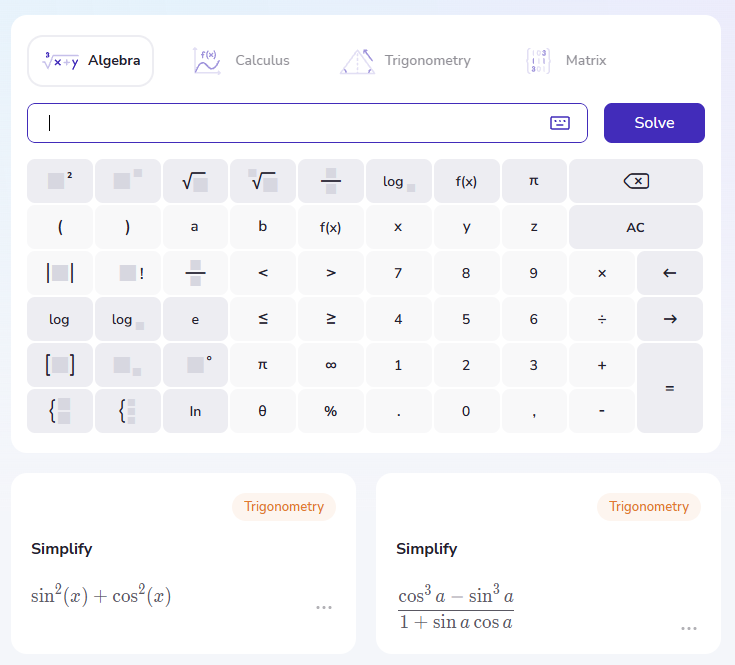
Simplifying radicals is an important skill in mathematics, especially in algebra and higher-level math. However, many students find radical expressions confusing and time-consuming. Square roots, cube roots, and complex radicals often require multiple steps, and one small mistake can lead to the wrong answer. This is why students increasingly rely on a how to simplify radicals calculator to understand and solve these problems correctly.
In this article, we’ll explain what radicals are, how to simplify them manually, and how a simplify calculator can make learning faster and easier.
What Are Radical Expressions?
A radical expression is a mathematical expression that contains a root symbol, such as:
- Square roots (√)
- Cube roots (∛)
- Higher-order roots
For example:
- √8
- √50
- ∛27
The goal of simplifying radicals is to rewrite them in their simplest form so they are easier to work with in equations and formulas.
Why Simplifying Radicals Is Important
Learning how to simplify radicals helps students:
- Solve algebraic equations correctly
- Prepare for exams and quizzes
- Understand advanced math topics like geometry and calculus
- Avoid careless mistakes
Teachers often require answers in simplified radical form, so knowing the correct method is essential.
How to Simplify Radicals Manually
Before using a calculator, it’s helpful to understand the basic process.
Step 1: Factor the Number Inside the Radical
Break the number into factors that include perfect squares.
Example:
√18
Factor 18:
18 = 9 × 2
Step 2: Separate the Perfect Square
Rewrite the radical:
√18 = √(9 × 2)
Step 3: Simplify
Take the square root of the perfect square:
√9 = 3
Final answer:
3√2
This process works, but it can become difficult with larger numbers or complex expressions. That’s where a how to simplify radicals calculator becomes extremely useful.
What Is a Simplify Calculator?
A simplify calculator is an online or AI-powered tool that automatically simplifies mathematical expressions, including radicals. Instead of manually factoring and checking each step, students can enter the expression and receive an instant result.
The best calculators don’t just give answers — they also explain each step clearly.
How a How to Simplify Radicals Calculator Works
A modern radical calculator follows these steps:
- Identifies the type of radical
- Breaks the number into prime or square factors
- Extracts perfect squares from under the radical
- Displays the simplified result
- Shows step-by-step explanations
This makes learning much easier, especially for beginners.
Example Using a Simplify Calculator
Problem:
√72
Manual steps:
- Factor 72 = 36 × 2
- √36 = 6
Final answer:
6√2
A simplify calculator instantly performs these steps and explains them clearly, saving time and reducing errors.
Benefits of Using a How to Simplify Radicals Calculator
1. Saves Time
Instead of spending 10–15 minutes on one problem, students get answers instantly.
2. Improves Accuracy
Calculators reduce the risk of small arithmetic mistakes.
3. Step-by-Step Learning
Seeing the solution process helps students understand why the answer is correct.
4. Builds Confidence
When students understand the steps, radicals no longer feel intimidating.
5. Useful for All Levels
From middle school algebra to college math, a simplify calculator helps at every stage.
When Should You Use a Simplify Calculator?
A calculator should be used as a learning tool, not a shortcut. It’s best for:
- Checking homework answers
- Practicing before exams
- Learning new radical concepts
- Understanding mistakes
Students who review the steps learn faster than those who only copy answers.
Common Mistakes Students Make With Radicals
Even strong students make errors, such as:
- Forgetting to factor completely
- Simplifying incorrectly
- Leaving perfect squares inside the radical
- Mixing coefficients and radicals
A how to simplify radicals calculator helps catch these mistakes early.
Can Simplify Calculators Replace Learning?
No — and they shouldn’t. Calculators are best used to support learning, not replace it. Teachers explain concepts, while calculators help students practice and verify their work.
Used correctly, a simplify calculator acts like a personal tutor that is always available.
Final Thoughts
Simplifying radicals doesn’t have to be difficult or frustrating. By understanding the basic steps and using a reliable simplify calculator, students can improve accuracy, save time, and build strong math skills.
A how to simplify radicals calculator is especially helpful for practicing problems, checking answers, and learning step-by-step solutions. When used responsibly, it turns complex radical expressions into simple, understandable results.
Mastering radicals is a key step toward success in algebra and beyond — and the right calculator makes that journey much smoother.